
As the world changes at lightning speed, it can be calming to stop and revisit some of the age-old success principles. When it comes to building a brilliant business, the principles laid out by Stephen Covey in his acclaimed book, The 7 Habits of Highly Effective People (1989), help us balance both personal and professional effectiveness. In this blog, we look at his step-by-step guidance and how you can apply it to your own business.
Habit 1: Be proactive (principles of personal vision)
“Habit 1: Be Proactive is about taking responsibility for your life. You can’t keep blaming everything on your parents or grandparents. Proactive people recognize that they are “response-able.” They don’t blame genetics, circumstances, conditions, or conditioning for their behavior. They know they choose their behavior. Reactive people, on the other hand, are often affected by their physical environment. They find external sources to blame for their behavior. If the weather is good, they feel good. If it isn’t, it affects their attitude and performance, and they blame the weather. All of these external forces act as stimuli that we respond to.
Between the stimulus and the response is your greatest power–you have the freedom to choose your response. One of the most important things you choose is what you say. Your language is a good indicator of how you see yourself. A proactive person uses proactive language–I can, I will, I prefer, etc. A reactive person uses reactive language–I can’t, I have to, if only. Reactive people believe they are not responsible for what they say and do–they have no choice. Instead of reacting to or worrying about conditions over which they have little or no control, proactive people focus their time and energy on things they can control.”
How to become more proactive in business
At Beyond, being a leading adopter in Ireland of new business solutions, like online accounting software, allowed the team to embrace disruption and use it to become more proactive with our clients. Live data and insights allow us to proactively help our clients to make better decisions for their business and empowers them to take action in real time rather than relying on the historical or redundant information provided by a traditional, reactive accountant.
There is usually very little value in knowing where your business went wrong some nine or 12 months after the fact. In addition to adopting such technologies and new accounting principles, the Beyond team has also spent a great deal of time thinking about we can embed proactive behaviour into our culture.
4 ways you can be more proactive in your business
Here are five ways you could be more proactive in your business, starting today:
- Survey your clients: It is always an eye-opening exercise to get direct feedback from the people who actually buy your product or service, and find out what you do well and where you could be more proactive to serve them better. What better way to find out than to ask them! You could do this via an an online survey or, even better, by meeting some of them face to face. This doubles as both a fact-finding mission for your business as well as a much appreciated act of service to your client.
- Update your website and online profiles: Spend some time reviewing the language used on your website, social media, and online profiles. What could be added or adjusted to reflect a more proactive nature? This might even include the addition of some customer testimonials obtained in your survey from point 1, or a more in depth client case study to show how proactive your business is.
- Change your own behaviour: The choice to be proactive is not just one that is relevant to your business. It applies just as much on a personal level. Every day, you have the choice as to how you are going to take on the day. Is the weather going to affect your mood for the day? Are what people say and do to you going to affect how you say and do things to others? We all have the choice to be proactive each day. Do you need to make a different choice tomorrow?
- Be more proactive with how you manage your business: Is it possible that you are making reactive decisions in your business because you are relying on yesterday’s information? Maybe you could think of ways to manage your business more proactively; learn to lead your business, instead of letting your business lead you! A great place to start is your businesses finances.
Habit 2: Begin with the end in mind (principle of personal leadership)
“Habit 2 is based on imagination – the ability to envision in your mind what you cannot at present see with your eyes. It is based on the principle that all things are created twice. There is a mental (first) creation, and a physical (second) creation. The physical creation follows the mental, just as a building follows a blueprint. If you don’t make a conscious effort to visualise who you are and what you want in life, then you empower other people and circumstances to shape you and your life by default. It’s about connecting again with your own uniqueness and then defining the personal, moral, and ethical guidelines within which you can most happily express and fulfil yourself.
Begin with the End in Mind means to begin each day, task, or project with a clear vision of your desired direction and destination, and then continue by flexing your proactive muscles to make things happen. One of the best ways to incorporate Habit 2 into your life is to develop a Personal Mission Statement. It focuses on what you want to be and do. It is your plan for success. It reaffirms who you are, puts your goals in focus, and moves your ideas into the real world. Your mission statement makes you the leader of your own life. You create your own destiny and secure the future you envision.”
How leadership vision means beginning with the end in mind
When Rory started Beyond, he had a very clear vision of building a business that was based on developing relationships and providing a service to business owners that they weren’t used to receiving from their accountant. A decade on, we truly live this. When we established the initial values, vision and the future mission of Beyond, we thought about where we would like to take Beyond as a business over the next 10-20 years.
We knew we would be the accounting firm of choice for Irish businesses. So what are we doing to connect the dots? How are we ensuring the path to this vision is clear and guided? We revisit our overall strategic and operational plan for the business for the next 10 years, 3 – 5 years, 1 year, and the next 90 days. We have consolidated these plans into a one-page business plan. Given the fast-paced world we live in, the one-page plan has many layers and changes in many ways. Its solid foundations are based on our:
- unique core values that we want to live by;
- core competencies that we want to be known for;
- Big Hairy Audacious Goal (BHAG) that we want to strive for in the next 10 years; and
- underpinning all of that is our WHY – our purpose – which we have clearly articulated.
3 ways you can begin with the end in mind in your business
Here are three ways you can begin with the end in mind in your business, starting today:
- Complete this exercise: In 10 years’ time, a newspaper decides to do a story about you and your business. They interview four people about you. These could be mentors, friends, family or colleagues. What would you want them to say about you and your journey in business?
- Develop a personal mission statement: As the book says, a great way to incorporate Habit 2 into your life is to develop a Personal Mission Statement. Your mission statement focuses on what you want to be and do. It is your plan for success. It reaffirms who you are, puts your goals in focus, and moves your ideas into the real world. Your mission statement makes you the leader of your own life. Set some time aside to write down the above points in relation to what you want to achieve.
- Complete a one-page business plan: A great way to bring your vision to life for your business is to get it down on paper and articulate it in a simple, clear and concise way. A one-page business plan template will help you here.
Habit 3: Put first things first (principles of personal management)
“Habit 1 says, ‘You’re in charge. You’re the creator.’ Being proactive is about choice. Habit 2 is the first, or mental, creation. Beginning with the End in Mind is about vision. Habit 3 is the second creation, the physical creation. This habit is where Habits 1 and 2 come together. It happens day in and day out, moment-by-moment. It deals with many of the questions addressed in the field of time management. But that’s not all it’s about. Habit 3 is about life management as well – your purpose, values, roles, and priorities. What are ‘first things?’ First things are those things you, personally, find of most worth. If you put first things first, you are organizing and managing time and events according to the personal priorities you established in Habit 2.”
How to apply this time management trick to your business
There is no question that in business and in our personal lives, time is one of our most precious commodities. How we manage time in our business is an essential skill and one that deserves attention. We believe the following four areas of focus and associated activities are a great place for business owners to start when it comes to managing their time and putting first things first:
- Take stock of where your time is going by making notes and checklists which recognise the multiple demands on our time. With these lists, you can determine what you need to stop doing, keep doing, or delegate. Over a 30-day period, it is guaranteed that you will see a trend of activities that fall into these three categories.
- Use your calendar more effectively to manage your days/weeks/months. Your calendar can be an incredibly powerful tool if it is used properly. What’s currently in your calendar? Spend some time adding calendar events for important business initiatives (marketing time, sales time, delivery time, and working ON business time), add general appointments, family engagements, time with your team. Just by structuring your calendar properly, you will reduce the ability for activities that steal focus and attention to creep in and allow you to give more undivided attention to the task at hand – the one your calendar says you should be doing at that very minute!
- Plan your day. Keep a day planner that priorities your activities, gives focus, clarifies values for the day and highlights the overarching goals that are helping you move forward. Nothing feels better than crossing things off your daily to-do list!
- Start saying no. Make it a goal to start saying no to something at least once a day if it doesn’t sit inside quadrant 2 of the matrix below. This matrix highlights the activities that generally occupy our time. Unfortunately, for many business owners, most of their time gets taken up by quadrant 3 activities – ones that are supposedly urgent, but not important. Quadrant 2 is where most of your time, as a business owner, should be spent going forward.
A quadrant for setting priorities
| URGENT | NOT URGENT | |
| IMPORTANT | Quadrant 1 • Crises • Pressing problems • Deadline-driven projects, meetings, preparations | Quadrant 2 • Preparation • Prevention • Values clarification • Planning • Relationship building • True recreation • Empowerment |
| NOT IMPORTANT | Quadrant 3 • Interruptions, some phone calls • Some mail, some reports • Some meetings • Many proximate, pressing matters • Many popular activities | Quadrant 4 • Trivia, busy work • Some phone calls • Time wasters • ‘Escape’ activities • Irrelevant mail • Excessive TV |
When you spend as much time in quadrant 2 as possible, you will notice that you become more focussed on the opportunities in your business. You can feed the possibilities and starve the problems by anticipating them and planning to prevent crises from happening. It isn’t easy getting to this stage. Creating an awareness of your personal management skills using the four activities listed above is a great place to start. These activities will put you on the path to taking control of your time and truly put the ‘first things first’ in your business and life in general.
Habit 4: Think win-win (principles of interpersonal leadership)
“Win-win sees life as a cooperative arena, not a competitive one. Win-win is a frame of mind and heart that constantly seeks mutual benefit in all human interactions. Win-win means agreements or solutions are mutually beneficial and satisfying. We both get to eat the pie, and it tastes pretty darn good!”
Thinking win-win is predicated on the ability to embrace and encourage human interaction and collaboration. When we look at how most people learn, our experiences and level of self-worth are based on comparisons and competition. We tend to think about succeeding in terms of someone else missing out or even failing – If I win, you lose. When we live our lives like this we soon realise how unfulfilling it is and that life in general becomes a zero-sum game. It doesn’t have to be this way, there is another way to go about things.
“Many people think in terms of either/or: either you’re nice or you’re tough. Win-win requires that you be both. It is a balancing act between courage and consideration. To go for win-win, you not only have to be empathic, but you also have to be confident. You not only have to be considerate and sensitive, you also have to be brave. To do that – to achieve that balance between courage and consideration – is the essence of real maturity and is fundamental to win-win.”
How to apply win-win thinking to your business
The habit of living your life based on thinking about a win-win outcome sees us cooperating more than competing. Win-win means agreements or solutions are mutually beneficial and satisfying. If we think about the win-win process in relation to how you run your business, we could consider it as a four-step process:
- For each daily problem or challenge that you encounter – before jumping into defensive mode or reacting to the situation – think about the situation from the others point of view, in terms of the needs and concerns of the other party.
- Identify the key issues and concerns involved.
- Determine what results would make a fully acceptable solution.
- Identify new options to achieve those results that can benefit everyone involved.
Habit 5: Seek first to understand, then to be understood (principles of empathetic communication)
“Communication is the most important skill in life. You spend years learning how to read and write, and years learning how to speak. But what about listening? What training have you had that enables you to listen so you really, deeply understand another human being? Probably none, right?”
Have you ever experienced one of those moments when you are so busy working out in your head what you are going to say next that you don’t actually take in a word of what the other person said? We see it all too often in business, where many people seek first to be understood, aka to get their own point across straight away. In this approach, we tend to ignore the other person we are interacting with completely.
Why listening is an essential part of effective communication
Most people listen with the intent to reply, not to understand. “Oh, I know just how you feel. I felt the same way.” “I had that same thing happen to me.” “Let me tell you what I did in a similar situation.” This is a persistent habit that causes people to filter everything they hear through their own life experiences, their own specific frame of reference. The most common types of responses tend to reflect one or more of these four approaches:
- Evaluating: You judge and then either agree or disagree.
- Probing: You ask questions from your own frame of reference.
- Advising: You give counsel, advice, and solutions to problems.
- Interpreting: You analyse others’ motives and behaviours based on your own experiences.
But what about adding to the list one more: simply listen? At Beyond, we try to align our internal and client conversations with this principle. Business can often be a lonely world for the owners with no one to talk to, and more importantly no one to listen to their struggles and challenges. Using this habit allows us to understand the needs and objectives of our clients and give them the confidence that they are truly being heard and understood. Rather than just blindly prescribing an accounting solution for them, we can work together to build out a solution that focuses on addressing and resolving their concerns along with exploring areas of opportunity within each challenge they face.
How to develop your communication skills
- Devote time to asking your clients/customers how they are doing and, if appropriate, what’s keeping them up at night. Stop everything you are doing and just listen to them. Listen with intent, without trying to respond, without trying to solve their problems. At the end, relay back to them what they’ve told you.
- Do the very same exercise with your team members.
- Do the very same exercise with your family members and closest friends.
When you seek to understand others, there are a couple of important and special things that will start to happen. Firstly, your relationship and rapport with them will grow stronger and they will be more open and honest with you as a result. Rapport builds trust and when you are trying to achieve ambitious goals, build your team, grow your business and improve your lifestyle, trust is everything. Second, your words will tend to hold more weight with people. For those that you have made a point to understand better, when you tell them something, it will tend to carry more weight.
Habit 6: Synergize (principles of creative cooperation)
“When properly understood, synergy is the highest activity in all life—the true test and manifestation of all of the other habits put together. The highest forms of synergy focus the four unique human endowments, the motive of Win/Win, and the skills of empathic communication on the toughest challenges we face in life. What results is almost miraculous. We create new alternatives—something that wasn’t there before.
Synergy is the essence of principle-centered leadership. It is the essence of principle-centered parenting. It catalyzes, unifies, and unleashes the greatest powers within people. All the habits we have covered prepare us to create the miracle of synergy.
What is synergy? Simply defined, it means that the whole is greater than the sum of its parts. It means that the relationship which the parts have to each other is a part in and of itself. It is not only a part, but the most catalytic, the most empowering, the most unifying, and the most exciting part.”
The synergise habit thrives on the ideology that ‘together is better’; that solutions will be better and more effective if produced by the collective rather than the individual. Synergy allows for joint discovery of things we are much less likely to discover by ourselves. It is the idea that the whole is greater than the sum of the parts.
Why learning cultures start with synergy
Synergy can occur only when it is ingrained in the process – it doesn’t happen on its own. It is through such process that the collective can bring their own experiences, beliefs, expertise, and ideas to the table. Individual contribution is welcomed, heard, understood, embraced, and constructively debated. When people begin to interact together, in a genuine way, they’re open to each other’s influence and can begin to learn from one another. Valuing and embracing differences is what really drives synergy. Do you truly value the mental, emotional, and psychological differences among people? Or do you wish everyone would just agree with you, so you could all get along?
Synergy allows you to:
- Value the differences in other people as a method of expanding your perspective
- Look for the good in others
- Exercise courage to be open and encourage others to be open
- Accelerate creativity and find a solution that will be better for everyone by looking at the alternatives
How you can introduce synergy to your business
We start with habits 4 and 5 – think win-win and seek first to understand. Once we have these in mind, we’re no longer on opposite sides of the problem. Instead, we are trying to collectively solve it. In this scenario, we are together, looking at the problem, understanding all the needs, and working to create an alternative that will meet them. What we end up with is not a transaction, but a transformation. Both sides get what they want, and they build their relationship in the process.
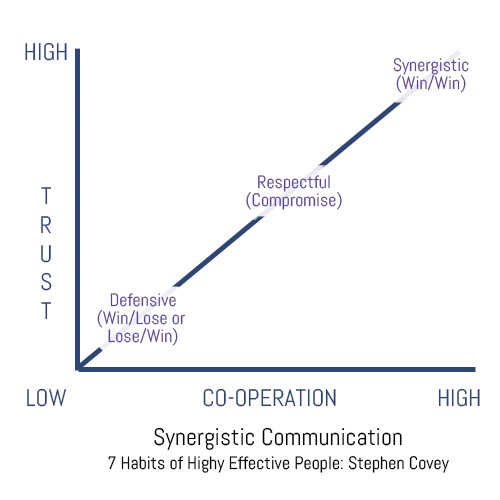
“The key to valuing differences is to realize that all people see the world, not as it is, but as they are.” Stephen Covey
Habit 7: Sharpen the saw (principles of balanced self-renewal)
“Habit 7 is taking time to sharpen the saw. It surrounds the other habits on the Seven Habits paradigm because it is the habit that makes all the others possible. It’s preserving and enhancing the greatest asset you have—you. It’s renewing the four dimensions of your nature—physical, spiritual, mental, and social/emotional.
Although different words are used, most philosophies of life deal either explicitly or implicitly with these four dimensions. Philosopher Herb Shepherd describes the healthy balanced life around four values: perspective (spiritual), autonomy (mental), connectedness (social), and tone (physical). George Sheehan, the running guru, describes four roles: being a good animal (physical), a good craftsman (mental), a good friend (social), and a saint (spiritual). Sound motivation and organization theory embrace these four dimensions or motivations—the economic (physical); how people are treated (social); how people are developed and used (mental); and the service, the job, the contribution the organization gives (spiritual).”
Why continuous self-improvement is the key
Sharpen the saw means preserving and enhancing the greatest asset you have – you. It is a habit and principle to live your life on. A journey of ongoing, never-ending and continuous self-improvement. To help us all figure out our relationship with time, personal change and sharpening the saw, Covey balances the concept across 4 main categories – physical, spiritual, mental, and social/emotional.
Sharpening the saw must be balanced across these four dimensions, otherwise a disparity will be created. We can offset an imbalance for a while, but not for the long-term. When businesses ignore this four-dimensional balance, inefficiencies, defensiveness and lack of synergy (Habit 6) ensues, creating a loss in productively, customer satisfaction and, ultimately, profitability and business sustainability.
We should consider sharpening the saw as an ongoing process of personal change. It’s not something that we can just do once or go hard at for a short period of time, believing that we’ve found an everlasting quick fix. It is about defining what success is in your own balanced, four-dimensional life. Remember, success is different for everyone, so its understanding what your version of success is across these four dimensions that is important. As a business owner and leader, part of your role is to help the people who report to you and look up to you explore these dimensions and establish goals for themselves.
How to find time to sharpen the saw
It’s a given that we are all busy with little perceived time to work on ourselves. However, our future success and ongoing reputation depends on us taking action and dedicating time to sharpen the saw. Here is a list of activities you could take up to sharpen the saw:
- Physical: daily exercise challenge, meditation and yoga, reviewing your diet and introducing better foods, cutting down on guilty pleasures you know aren’t good for you, monitoring sleep and getting more consistent sleeping patterns, taking up a sport or team activity, walking the dog or going for a walk with your partner or children.
- Spiritual: spending more time at your local religious or spiritual meeting place, spending more time in nature through walking or hiking outdoors, exploring your belief system and meeting people who practise it to ask more questions, meditating and practising mindfulness, taking time out from work each day to go for a walk.
- Mental: journaling and writing daily, setting and writing down your goals, downloading a brain training app, reading more books, signing up to a course online or in person, listening to a new podcast, watching educational videos on YouTube, teaching your children, friends or family a skill you know, teaching your team members a new skill, giving a presentation, doing a Toastmasters course to improve public speaking.
- Social/emotional: joining a community group, meeting your neighbours and inviting them to dinner, volunteering for a local charity of interest, seeing a counsellor and talking about your life (you don’t have to be in crisis to see these professionals), spending quality time with your closest friends, spending quality time with your family both immediate and extended, going to a music concert.
Over time, remembering to sharpen your saw will get easier to plan and do. Whatever you choose will become the solid foundation for a life of quality. As you renew yourself in each of the four areas, you create growth and change in your life. Sharpening the saw keeps you fresh, so that you can continue to practice the other six habits effectively.