
As we finish the ‘Strategy’ section of Scaling Up by Verne Harnish, the time has finally come to tackle the famous One-Page Strategic Plan, or OPSP. This double-sided sheet is the most recognised and widely used element of the Scaling Up methodology.
This blog is part of a series looking at the habits required to successfully scale a sustainable business. Read our introduction about the Scaling Up book and how to implement it in your business, which includes a complete list of all the blogs that explore this book.
The hard work you have done to this point in clarifying your core values, purpose, and key strategic choices, will now be translated into focused priorities and measurable actions by your OPSP. It acts as the bridge between defining your direction and implementing it. This chapter takes you through the components of an effective OPSP, and for smaller companies it introduces the simplified version – the Vision Summary.
What exactly is an OPSP?
The One-Page Strategic Plan (download the editable PDF) is a structured, internal tool that turns a vision into a practical plan by answering seven core questions: who, what, when, where, how, and why, plus ‘should we or shouldn’t we?’ It creates a clear framework that aligns the organisation both horizontally and vertically, ensuring everyone is on the same page.
The layout separates enduring core elements – like purpose, values, and brand promise – from dynamic, growth-focused priorities. As you work through each section, the pieces begin to fit together to reveal a complete picture of your strategy – guiding decisions and providing a living roadmap to keep your vision current and actionable.
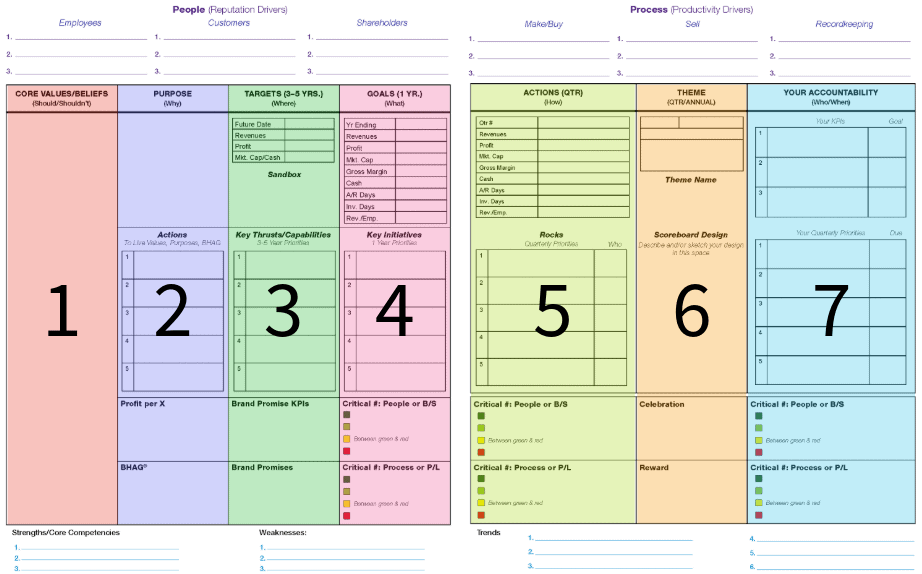
This chapter also introduces an alternative to SWOT analysis, called SWT – strengths, weaknesses, and trends (there’s also a space at the bottom of your OPSP to fill these out). When it comes to strategic thinking, the point is not to fixate on one competitor next door, but the big trends (global changes in tech, innovation, markets, society, distribution) that could shake up your industry and business.
OPSP Column 1: Core Values/Beliefs
In the first column, list three to eight phrases that define the ‘shoulds’ and ‘shouldn’ts’ of the business and capture its personality. The focus is on practical use; these values help guide decisions, maintain culture, and ensure alignment as the organisation grows. The label is flexible – you can call them Core Values, Beliefs, Rules, or anything that resonates – but the goal is to give the team a shared, actionable framework to keep the culture strong and consistent.
OPSP Column 2: Purpose, Profit per X, and BHAG®
This column clarifies why the company exists, how it makes money, and where it is headed. “If the first column represents the soul of the organization (or organism), then column 2 presents its heart.” Review the work you did when working on The Core chapter to help capture your purpose – the company’s reason for being that goes beyond profit and gives meaning to the work.
Profit per X identifies the key economic driver, such as profit per customer, transaction, or product, which the team can track to measure financial health. Your Big Hairy Audacious Goal, or BHAG®, is the bold, long-term goal that inspires and stretches the company (see the 7 Strata chapter). Together, these three elements provide a clear lens for decision-making and a shared target that unites the team around both meaning and growth.
OPSP Column 3: Targets, Sandbox, and Brand Promises
At Column 3, your plan starts to become more granular. Targets (revenues, profit, market cap or cash) define measurable milestones that track progress toward the BHAG®, showing what success looks like. Start by deciding what kind of timeframe you will plan for: three, four, or five years if growth is steady and slow. If growth is faster, a shorter horizon makes sense. If the company is growing very quickly, then even one year can feel like three to five in a normal business, so you compress the plan. The point is to keep your plan realistic and aligned with how fast things are moving.
The Sandbox sets the boundaries of the market, customers, or segments the company will compete in, focusing resources and effort. It’s based on Stratum 2 of the 7 Strata worksheet. Brand Promises (and their KPIs) articulate the specific value the company consistently delivers to customers, translating purpose and values into tangible experiences.
To finish off this column, identify the three to five Key Thrusts or Capabilities your company must focus on over the next few years. These are the major initiatives that will drive growth and shape the business, whether it’s launching a new product line, making strategic acquisitions, or dramatically refocusing the core business. To increase the chances of success, assemble a board of advisors – people with experience in the areas you’re aiming to tackle – so you can learn from those who have already navigated similar challenges.
OPSP Column 4: Goals
Column 4 turns your medium-term priorities into the specific objectives and Key Initiatives for the year. Start by defining your expanded financial outcomes at the top, changing or discarding any that aren’t relevant to your business (for example, tracking staff utilisation if inventory isn’t significant). Next, identify the one Critical Number for the year, “the main thing that will be the main thing.” This focuses the team on the single most important metric.
This number should address either a People/Balance Sheet challenge, like reducing turnover or improving customer service, or a Process/Profit & Loss challenge, like improving margins or speeding up production, with a counterbalancing metric to avoid unintended consequences. Finally, in the middle of the column, list a handful of Key Initiatives that will drive the business toward these outcomes. Keep the list short, focused, and revisable as circumstances change, always ensuring each initiative directly supports the Critical Number (see The Priority chapter).
OPSP Column 5: Actions
Column 5 translates the annual goals and Critical Number from Column 4 into concrete actions for the next 90 days. At the top, set precise quarterly financial outcomes, and at the bottom, define a quarterly Critical Number – one that’s a key step towards achieving the yearly target.
Next, you’ll identify a handful of Rocks, the three to five most important priorities for the quarter that will drive results. Assign accountability for each Rock by noting the responsible person. The idea is to treat these Rocks like short sprints focused on the getting the most important work done first so that the team makes measurable progress each quarter while keeping longer-term goals in sight.
OPSP Column 6: Theme, Scoreboard Design, and Celebration/ Reward
The Theme column brings motivation and measurement together with a focus for the period that energises the business around a key strategic priority. Together, these elements create rhythm, focus, and shared accountability that sustain execution over time.
It breaks down into these core areas:
- a Deadline, usually at the end of the current quarter
- a Measurable Target, which is the quarterly Critical Number from the bottom of column 5
- a Name, something a fun, catchy, and relevant
- a Scoreboard Design for a physical or digital board where the score is updated daily or weekly and visible to everyone
- a Celebration, an event (ideally one that aligns with the theme title) to either celebrate the accomplishment of a big goal or commiserate
- a Reward in the form of prizes that align with the theme, or a monetary incentive
OPSP Column 7: Your Accountability
The final column specifies who is responsible for each element of the plan and the outcomes tied to it. This prevents confusion, ensures follow-through, and builds a culture of ownership. By naming accountable individuals, the OPSP turns strategic intentions into real action, making it obvious who must act, when, and how success will be measured. “If everyone can accomplish one thing in addition to his or her daily job, that’s a dozen improvements every quarter, or hundreds, depending on the number of employees.”
People and Process (Reputation and Productivity)
Although now packed with vital information, your OPSP is not quite done. Across the top is a space for the two sides of your business, the people and the processes. On the people side we have employees, customers, and shareholders, while on the process side we have make/buy, sell, and recordkeeping.
Achieving your vision depends on balancing these two sides of the business. You want happy stakeholders without sacrificing efficiency, and strong processes without damaging relationships. Choose one or two weekly KPIs to track across both, such as engagement scores for employees, cash flow for shareholders, or close ratios for sales performance.
Ready to start working on your OPSP?
The key takeaway from this chapter is that scaling is about creating a living, working plan that aligns every part of the business, from purpose to daily actions. The OPSP forces you to turn complexity into simplicity. Decide what really matters, who’s responsible, and how progress will be measured. When you connect vision to execution, every person, target, and number shares a direction. Because, in the end, the difference between talk and traction is discipline.
Did you know that Beyond businesses are three times more likely to grow? We partner with ambitious businesses committed to scaling. Talk to us about how we can help.
Rory
All the blogs in this series









P.S. If you find our articles informative, you can add us to your preferred Google search sources.